Why Physical Music Is Exploding Again: Vinyl, CDs, Cassettes and the Need to Own Something Real
CrateTrax Editorial ·
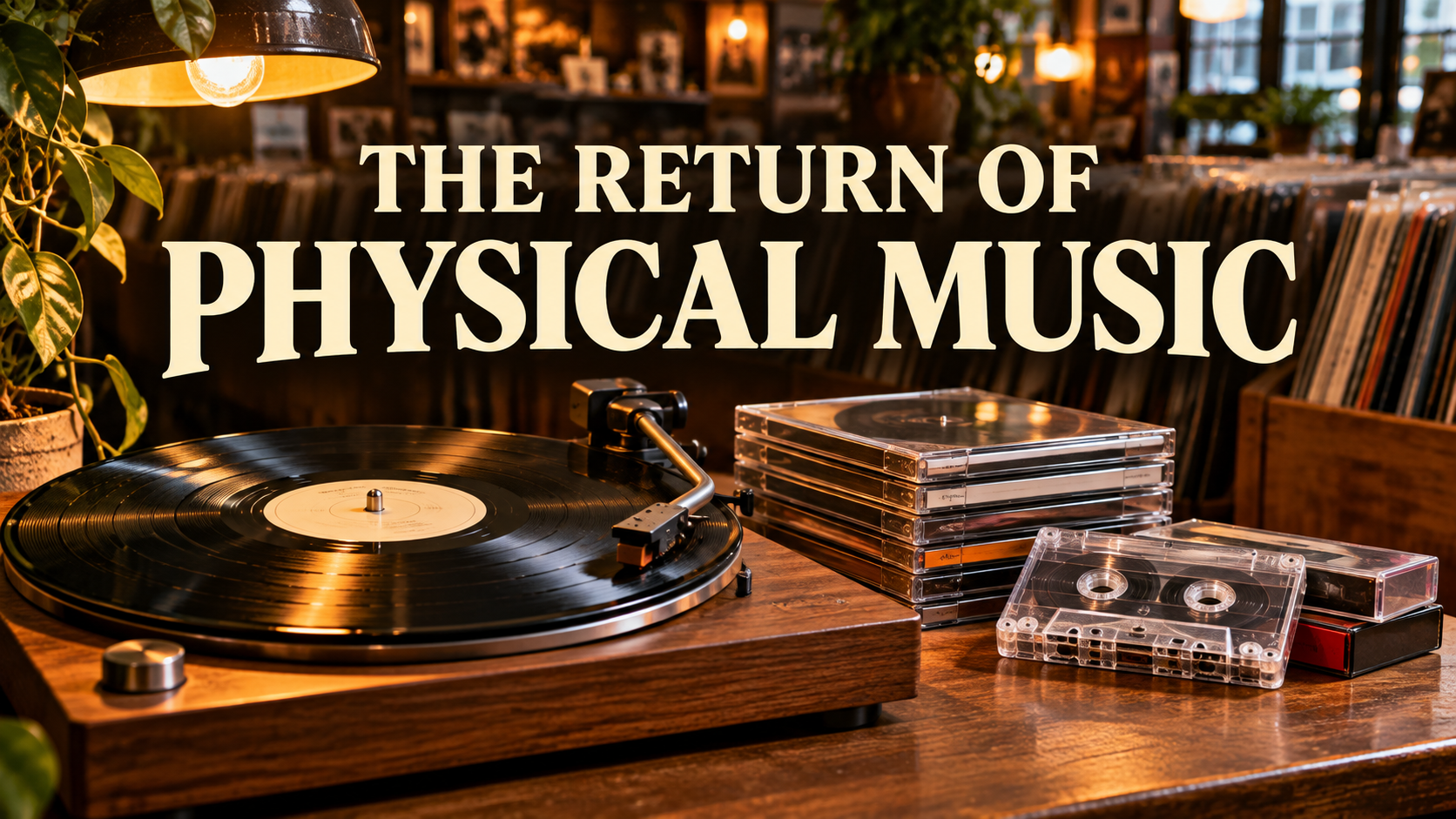
The Return of Physical Music: Why Vinyl, CDs and Cassettes Are Exploding Again
There was a time when the future of music seemed obvious. Everything was going digital. Records were outdated, cassette tapes were collecting dust, and CDs were destined for the same fate as VHS tapes. Streaming had won, and the idea of owning music seemed increasingly unnecessary.
Except something unexpected happened.
People started buying music again. Not downloading it. Not streaming it. Actually buying it.
Vinyl records began disappearing from store shelves. Independent record shops found new audiences. CDs, once considered practically obsolete, started making a surprising comeback. Even cassette tapes, with their hiss, tangled ribbons, and decidedly imperfect sound, found a new generation of collectors.
And here's the fascinating part: Much of this resurgence is being driven by people who grew up with Spotify, Apple Music, and YouTube.
The generation with more access to music than any other in history is rediscovering the value of actually owning it.
This isn't simply nostalgia. It's something much bigger.
It's a reaction to an increasingly digital world, a desire to reconnect with the past, and perhaps most importantly, a reminder that music was never supposed to be just another disposable piece of content.
The Numbers Don't Lie: Physical Music Is Back
For years, the vinyl revival was dismissed as a passing trend driven by aging collectors and hipsters buying vintage turntables.
That argument is becoming increasingly difficult to defend.
According to the Recording Industry Association of America (RIAA), vinyl sales in the United States surpassed $1 billion in revenue during 2025, increasing 9.3% over the previous year.
It marked the 19th consecutive year of vinyl revenue growth.
Think about that for a moment. Vinyl has been growing for nearly two decades in an industry supposedly dominated by digital convenience.
And 2026 is making the story even more interesting.
In September, Reuters reported that U.S. physical music revenue jumped 25.9% during the first half of 2026, reaching $731.5 million.
CD revenue increased an astonishing 58.6%, while vinyl revenue climbed another 17.7%.
The RIAA reported that 17.5 million CDs were sold during the first six months of 2026, representing a 45.7% increase over the comparable period in 2025.
Meanwhile, the IFPI Global Music Report 2026 revealed that global physical music revenues grew 8% in 2025, reaching $5.3 billion.
Streaming remains the dominant format by a considerable margin. Nobody is suggesting otherwise.
But something important is happening alongside streaming's continued success.
People are discovering that having access to everything isn't the same as owning something.
We've Never Had More Music, Yet Something Is Missing
Consider how dramatically our relationship with music has changed.
Twenty-five years ago, discovering a great album often meant making a commitment.
You heard a song on the radio. Maybe a friend recommended a band. Perhaps you read a review in Rolling Stone or stumbled across an unfamiliar album cover at a record store.
Then you spent your money.
You brought that album home, removed the packaging, studied the artwork, read the liner notes, and listened.
Sometimes you loved it immediately. Sometimes it took several listens. Occasionally you bought something terrible.
But you gave the music a chance because you had invested in it.
Today, we have access to virtually every album ever recorded for roughly the price of a monthly subscription.
It's an extraordinary technological achievement.
It's also fundamentally changed the way we experience music.
Songs become background noise. Albums become collections of tracks to skip through. Recommendations are increasingly driven by algorithms rather than conversations, discoveries, or personal curiosity.
We can listen to almost anything, almost anywhere, at almost any time.
And yet, for many listeners, the experience feels less personal.
This is one of the great contradictions of the streaming era.
Music has never been more accessible, but our relationship with it can feel more disposable than ever.
Physical music offers an alternative.
Not necessarily a better way to discover music, but a different way to connect with it.
The Power of Holding Music in Your Hands
There's something difficult to explain about pulling a record from its sleeve.
You examine the cover. You carefully remove the vinyl. You place it on the turntable, lower the needle, and wait for the first notes.
It's a small ritual, but it changes the experience.
You aren't scrolling through notifications. You aren't skipping through dozens of recommended tracks. You aren't asking an algorithm what you should hear next.
You're listening to an album.
The same is true, in different ways, with CDs and cassettes.
Opening a jewel case, reading lyrics in a booklet, or inserting a cassette into an old tape deck creates a physical interaction with the music.
These moments might seem insignificant, but they're precisely what digital convenience has largely eliminated.
Physical media asks something of the listener.
It requires participation.
And that participation can make the experience feel more meaningful.
Of course, vinyl doesn't automatically sound better than digital audio. A properly mastered high-resolution digital recording can offer greater technical accuracy than an LP.
But the attraction of physical music isn't simply about sound quality.
It's about the experience surrounding the sound.
The ritual is part of the music.
Nostalgia for a Past You Never Experienced
One of the most fascinating aspects of the physical music revival is who's participating.
It's not just people in their 40s, 50s, and 60s rebuilding collections they sold decades ago.
It's teenagers and young adults.
People born long after vinyl stopped being the dominant music format are buying records, decorating their rooms with album covers, and searching thrift stores for vintage stereo equipment.
A May 2026 report from WUFT explored how younger collectors are embracing vinyl and CDs, sometimes building substantial collections despite growing up in an entirely digital environment.
For older collectors, an album might bring back memories of high school, a first concert, or a particular period in their lives.
For younger collectors, it offers something different.
A connection to a time they never personally experienced.
A Fleetwood Mac record might evoke the 1970s. A Nirvana CD might represent the alternative rock explosion of the 1990s. A cassette of a favorite hip-hop album might connect a listener to the culture and aesthetics of another era.
These objects become tangible connections to music history.
And in a world where so much culture exists only on screens, that connection matters.
It's also part of a broader fascination with analog experiences: film photography, vintage cameras, printed books, mechanical watches, and older technology.
Not because these things are necessarily more efficient.
Because efficiency isn't always what people are looking for.
Sometimes the imperfections are part of the appeal.
The CD Comeback Nobody Saw Coming
Vinyl gets most of the headlines, but CDs might be the most interesting story of 2026.
For years, compact discs seemed trapped between two worlds.
They lacked the vintage appeal of vinyl and couldn't compete with the convenience of streaming.
Now they're finding a new audience.
Part of the attraction is practical.
CDs are generally less expensive than newly pressed vinyl records. They're easier to store, more portable, and can deliver excellent digital audio quality.
Used CDs also offer collectors an affordable way to build substantial music libraries.
Walk into a thrift store or secondhand music shop, and it's still possible to find excellent albums for a fraction of what a new vinyl pressing might cost.
But the CD revival isn't entirely about affordability.
It's also about fandom.
As The Verge reported in September 2026, collectible editions, particularly within K-pop, have helped drive the format's remarkable sales growth.
Artists are turning CDs into elaborate physical packages featuring artwork, photo books, collectible cards, and exclusive content.
For many fans, the disc is only part of the appeal.
The album itself becomes a collectible object and an expression of their connection to the artist.
Perhaps the most revealing detail is that research cited by Statista found that just over half of Gen Z and Millennial CD buyers surveyed didn't even own a CD player.
They're purchasing the music as something to possess, display, and treasure.
That says something remarkable about the emotional value of physical media.
Even Cassettes Are Finding Their Audience
If the return of CDs seemed unlikely, the renewed interest in cassettes might be even more surprising.
By almost every technical measure, cassette tapes are inferior to modern digital formats.
They wear out. They can hiss. They require rewinding. They're susceptible to damage.
And yet, people are buying them.
According to Luminate figures discussed in Forbes' analysis of 2025 music data, approximately 446,500 cassettes were sold in the United States in 2025, an increase of 17.5% over 2024.
That's a tiny fraction of the overall music market, and it's important not to exaggerate the scale of the comeback.
But the growth is real.
For independent artists, cassettes can offer an inexpensive and distinctive way to release physical music.
For collectors, they're compact, relatively affordable, and visually interesting.
And for some listeners, the limitations are part of the experience.
A cassette forces you to engage with the music differently.
You can't instantly jump between thousands of songs. You listen to one side, flip the tape, and continue.
It's slower.
It's less convenient.
And for a growing niche of listeners, that's exactly the point.
In a World of Subscriptions, Ownership Matters Again
There's another reason physical music is becoming increasingly attractive.
We live in a subscription economy.
Music, movies, television, software, books, cloud storage, and countless other services are increasingly accessed through recurring payments.
The arrangement is convenient, but it comes with an important distinction.
Access is not ownership.
A streaming subscription provides access to a licensed catalog. That catalog can change. Albums can disappear because of licensing disputes, distribution changes, or decisions made by rights holders.
Even when music remains available, the version you remember might be replaced by a remaster or another edition.
Physical ownership offers something different.
Buy a record, CD, or cassette, and the copy belongs to you.
You can play it without an internet connection. You can lend it to a friend. You can give it to your children. You can sell it, trade it, or keep it for decades.
That doesn't make physical formats indestructible, and it doesn't mean streaming is inherently bad.
It simply means ownership offers a level of permanence that subscription access cannot guarantee.
As digital services become more deeply embedded in everyday life, the appeal of owning something tangible may only increase.
The Album Is Becoming Important Again
Streaming has fundamentally changed the economics and structure of popular music.
Individual songs can become enormous hits without listeners ever engaging with the albums surrounding them.
Short-form video platforms can turn a fifteen-second clip into a global phenomenon.
Playlists often replace albums as the primary way people discover new music.
But physical collecting pushes in the opposite direction.
It encourages listeners to think about the album as a complete work.
The sequencing matters.
The artwork matters.
The transitions between songs matter.
The closing track matters.
Consider albums like The Dark Side of the Moon, Rumours, Kind of Blue, Nevermind, The Miseducation of Lauryn Hill, or OK Computer.
These records weren't simply collections of interchangeable singles.
They were artistic statements designed to be experienced as a whole.
Physical media helps preserve that concept.
When you purchase an album, you're often buying into the artist's complete vision rather than one particular song.
That distinction becomes increasingly important as the music industry produces an overwhelming amount of new content.
Luminate's 2025 Year-End Music Report estimated that an average of 106,000 new ISRCs, identifiers assigned to individual recordings, were delivered to digital music services every day in 2025.
That's an extraordinary volume of material competing for attention.
In that environment, an album worth purchasing, displaying, and revisiting becomes something special.
It becomes music that has earned a permanent place in your life.
Record Stores Offer Something Algorithms Can't
One of the overlooked aspects of the physical music resurgence is the importance of community.
A great record store is more than a place to buy albums.
It's a place to discover music.
You walk through the doors without necessarily knowing what you're looking for.
You flip through bins. You recognize familiar covers. You stumble across something you've never heard of.
Maybe the person behind the counter recommends an obscure jazz recording or a forgotten rock album.
Maybe another customer notices what you're holding and starts a conversation.
Those interactions can create musical discoveries that feel fundamentally different from algorithmic recommendations.
The Luminate 2025 report found that approximately four in ten vinyl records sold in the United States were purchased through independent record stores.
That matters.
It suggests the vinyl revival isn't simply an online collectibles market.
Physical spaces and local communities remain important parts of the experience.
Events like Record Store Day have helped turn record shopping into something communal, bringing fans together around exclusive releases, live performances, and independent retailers.
Streaming can introduce you to an artist in seconds.
A record store can introduce you to another person who loves that artist just as much as you do.
Those are two very different kinds of discovery.
The Emotional Connection: Music as a Time Machine
Ask someone who has collected music for decades about their favorite records, and you'll often hear stories that have very little to do with the actual recordings.
They'll tell you where they bought the album.
Who they were dating.
What car they were driving.
Which friend introduced them to the band.
What concert changed their life.
The album becomes attached to a memory.
A worn record sleeve might remind someone of their teenage bedroom. A scratched CD might bring back memories of college road trips. An old mixtape might contain songs chosen by someone who is no longer in their life.
These objects carry personal history.
And unlike a streaming playlist, they can show the physical evidence of that history.
A handwritten note. A faded price sticker. A bent corner. A concert ticket tucked inside a sleeve.
To someone else, those imperfections might reduce the item's value.
To its owner, they might make it priceless.
That's something technology has never successfully replicated.
The emotional value of a collection isn't measured only by rarity, resale prices, or sound quality.
It's measured by the memories attached to it.
We're not just collecting music. We're collecting pieces of our lives.
Why the Physical Music Boom Could Continue
It's tempting to describe the current revival as another retro trend.
But several forces suggest physical music could remain an important part of the industry for years to come.
First, younger listeners are developing collecting habits that may continue as they get older.
Second, artists and labels are increasingly treating physical releases as premium experiences, offering special editions, elaborate packaging, and exclusive artwork.
Third, the growing subscription economy creates a continuing distinction between temporary access and permanent ownership.
Fourth, the sheer volume of digital content may encourage some listeners to become more selective about the music they truly value.
And finally, physical collecting provides something increasingly scarce in modern entertainment: a reason to slow down.
That doesn't mean vinyl, CDs, and cassettes will replace streaming.
They won't.
Streaming is too convenient, too affordable, and too deeply integrated into the way most people consume music.
There are also real limitations to physical collecting. New records can be expensive. Storage takes space. Playback equipment requires maintenance. Limited-edition releases can encourage speculative buying rather than genuine appreciation.
And sales growth won't necessarily continue at the same pace every year.
But the future doesn't have to be a competition between physical and digital.
The two formats can serve different purposes.
Streaming is extraordinary for exploration and convenience.
Physical media is extraordinary for ownership, connection, and collecting.
You can discover an artist through Spotify, fall in love with an album, and then decide it deserves a place on your shelf.
In many ways, that's the ideal relationship between the two.
The Future of Music Might Be More Physical Than We Think
There's something wonderfully ironic about the current moment.
We've spent decades developing technology designed to remove the friction from listening to music.
We eliminated the need to visit stores, carry albums, change discs, rewind tapes, and even decide what to play next.
We made music instant, unlimited, and almost effortless.
And now, millions of people are voluntarily bringing some of that friction back.
They're buying turntables.
They're hunting for used CDs.
They're collecting cassette tapes.
They're building shelves filled with music they could stream in seconds.
Not because they've rejected technology.
But because they've discovered that convenience isn't the only thing that matters.
Music has always been about more than sound.
It's about identity, memory, discovery, culture, and connection.
Physical formats give those experiences something tangible to attach themselves to.
And perhaps that's the real reason collecting is growing again.
In a world where everything is available but very little feels permanent, people are searching for things worth keeping.
The future of music isn't necessarily a return to the past. It's a future where the past still has a place on our shelves.
And that might be the most encouraging development in music collecting in decades.
At CrateTrax, we believe great music deserves more than a passing listen. Whether you're collecting your first record, rediscovering an old CD collection, or searching for that elusive pressing, every album has a story worth preserving.